
How to Redirect a Downspout Away From Your House: A Homeowner’s Guide
 Revised by Bruce Hulse
Why Downspout Direction Matters for Your Foundation
Improper downspout placement can lead to serious water issues around your home’s foundation. When rainwater is not guided far enough from the base of the house, it can saturate the soil, weaken structural components, and cause basement flooding. Learning how to redirect a downspout correctly protects your home from long-term water damage.
Signs It’s Time to Reroute Your Gutter Outlet
There are visible signs your current setup isn’t working. Water pooling at the base of your home, soil erosion, basement moisture, and even algae streaks on siding all indicate ineffective runoff control. Ignoring these warnings increases the risk of costly foundation repairs.
Planning Where to Redirect Runoff Safely
The goal is to move rainwater a minimum of five to six feet away from your house. Choose a route that slopes downhill and discharges into a safe area like a garden bed, gravel pit, or municipal runoff point. This helps protect both your structure and landscape. Careful planning of pipe routing ensures the discharge path avoids walkways, landscaping features, and neighboring properties.
Tools and Supplies You’ll Need
Before you begin, gather the following essentials:
- Downspout elbow or offset adapter
- Extension (rigid or flexible)
- Fasteners and brackets
- Gravel or splash blocks
- Measuring tape, level, and shovel
This ensures a smoother installation process and avoids mid-project delays.
Using Extensions to Redirect Downspouts
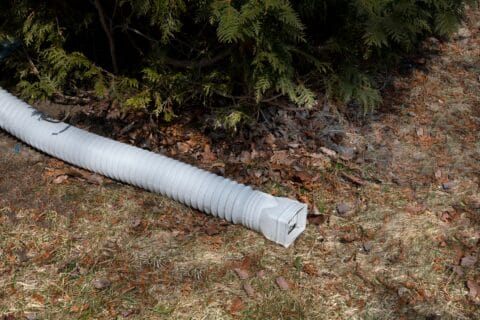
Adding an extension to your downspout is one of the simplest and most effective solutions. A properly installed downspout extension helps move discharge farther from the foundation and reduces soil saturation near the home. It involves attaching a longer extension to guide water away from your house, either above ground or below.
Comparison of Extension Types
| Extension Type | Best Use Scenario | Pros | Cons |
| Flexible Plastic | Temporary setups or curves | Easy to install | Less durable |
| Rigid PVC | Permanent redirection | Strong, weather-resistant | Harder to conceal |
| Buried Drain Line | Long-term, aesthetic fix | Invisible, efficient | Requires digging |
Redirecting Runoff With Elbows and Offsets
If your downspout discharges in an awkward direction, an elbow fitting allows you to change its angle. This small adjustment helps guide water around corners or away from walkways, driveways, or porches.
When to Consider an Underground System
Underground piping provides a hidden, permanent solution when surface extensions aren’t practical. A buried line can carry water to a dry well, swale, or storm sewer. Though more labor-intensive, it offers better protection and curb appeal.
Surface vs. Underground Drainage Systems
| Method | Visibility | DIY-Friendly | Long-Term Effectiveness |
| Surface Extension | Visible | Yes | Moderate |
| Underground Piping | Hidden | Moderate | High |
Getting the Slope Right
Downspout redirection only works when gravity is on your side. Your extension or underground line should slope about 1 inch per 10 feet. Use a level and measuring tape to check your gradient and ensure steady water movement.
Splash Blocks: A Simple Alternative
In tight spaces or during the planning phase, splash blocks can help channel water away. They’re inexpensive and quick to install. Place them under the downspout to guide water away without allowing it to pool at the base of your wall.
Legal and Municipal Considerations for Gutter Discharge Management
Before modifying your downspout system, it’s essential to check local bylaws and building codes. Some cities restrict where stormwater can be directed, especially if it could impact neighboring properties or public infrastructure. In many cases, redirecting water onto a neighbor’s land or into a street drain may violate municipal codes. Contact your local building department or a certified contractor to ensure your redirection plan complies with regulations. In some municipalities, downspout disconnection is required to reduce pressure on public storm systems and protect nearby properties.
Using Dry Wells as a Final Drainage Point
A dry well is a gravel-filled underground structure that collects and disperses stormwater safely into the surrounding soil. This is especially useful when there’s no natural slope or public drain available. Dry wells are often used in combination with underground piping to create an invisible, efficient water management system. They help prevent pooling in flat yards and protect foundations from moisture buildup.
Integrating a French Drain With Your Gutter Outlet
French drains are another excellent solution for managing redirected moisture. These trenches, filled with gravel and a perforated line, collect excess moisture and guide it away from the house. By connecting your existing setup to a French drain, you create a passive system that can handle large volumes over time. This technique is ideal for properties with heavy rainfall or clay-heavy soil that absorbs poorly.
Seasonal Adjustments for Different Climates
Water diversion systems must be adapted to regional climate conditions to remain effective year-round. In cold regions, above-ground pipes should be securely fastened to withstand frost heave, while underground components must be buried below the frost line to prevent cracking. In temperate, rainy areas, the focus should be on managing large volumes of runoff efficiently. In contrast, dry climates benefit from setups designed to improve soil absorption. Tailoring your configuration to local weather patterns ensures reliable performance and long-term protection of your property.
Downspout Diverters for Rain Barrels and Water Collection
If you’re environmentally conscious, consider adding a downspout diverter to connect your system to a rain barrel. This setup allows you to harvest rainwater for gardens, lawns, or outdoor cleaning. Many diverters are designed to automatically shut off once the barrel is full, redirecting overflow to the original drainage path. It’s a great way to combine redirection with water conservation.
Quick Tips for Effective Drainage
- Never direct runoff toward sidewalks or neighboring lots
- Avoid discharging water where it can pool around window wells or basement entries
How Redirection Helps Prevent Foundation Cracks
Excess moisture near the base of your property is a leading cause of foundation cracks. When moisture accumulates, it exerts hydrostatic pressure on basement walls. Over time, this pressure leads to cracking, shifting, and moisture intrusion. By properly directing downspouts away from your building, you relieve this pressure and preserve the structural integrity of your residence.
How Redirection Supports Healthy Landscaping
Redirected downspouts also protect your garden beds and lawn. Constant runoff near the home can oversaturate the soil, leading to root rot and erosion. With proper redirection, you prevent soggy patches, standing moisture, and unhealthy vegetation. You can even design the outflow to irrigate flower beds or lawn zones strategically.
Mistakes to Avoid During Installation
Many homeowners misjudge slope, use the wrong materials, or discharge water too close to the house. Other common errors include forgetting to anchor the extension, using incompatible connection sizes, or blocking the runoff path with landscaping.
Maintenance Is Key After Redirection
Even the best setup can fail without maintenance. Check your system seasonally for disconnected joints, ice buildup, clogs, or erosion near the exit point. If you notice overflow or backflow, investigate the source before bigger problems develop.
Enhancing Landscape Drainage Around Redirected Runoff
You can make redirection blend into your landscape with the right elements. Use gravel-filled trenches, river rocks, or decorative drains to manage excess water while maintaining curb appeal. Be sure the discharge zone can handle the volume without flooding.
Common Signs of Poor Gutter Outlet Performance
In addition to pooling water and damp basements, there are more subtle signs that your downspouts need attention. These include mildew around the foundation, paint peeling near ground level, or recurring mosquito infestations caused by standing water. Watch for these indicators even if major symptoms aren’t obvious.
Redirecting Multiple Gutter Outlets for Large Roofs
Homes with large or complex rooflines often have several downspouts. Redirecting just one may not be enough. Assess the entire system to determine whether all points are effectively managed. Combining redirection methods, for example, using underground piping for the front and extensions with splash blocks in the back, can provide balanced coverage for the entire property.
Partnering With Professional Services for Full Drainage Solutions
For more complex needs, working with a contractor or site management expert ensures your system is built to last. Professional drainage design helps account for slope, soil conditions, roof size, and local code requirements. Professionals evaluate slope, soil type, roof size, and code compliance to create a custom setup. This can include installing check valves, backflow preventers, or even smart diverters that activate during heavy rainfall. Services like Clear Ottawa’s gutter cleaning can serve as the first step in diagnosing any issues before planning redirection.
Efficient Gutter Runoff Repositioning
Redirecting a roof drain outlet is one of the smartest moves a homeowner can make to protect their foundation. Whether using simple extensions, buried lines, or customized angles, keeping moisture away from your residence is essential. Plan your system, use proper slope, and maintain it regularly to avoid costly foundation damage.
Bruce Adam Hulse


Bruce Adam Hulse is the passionate and driven CEO of Clear Ottawa Windows, a leading exterior cleaning and gutter maintenance company serving residential and commercial clients throughout the Ottawa region.
Learning how to clean downspouts is essential due to extreme seasonal shifts, from deep winter freezes to rapid spring thaws and heavy summer rains.…
Gutter overflow during heavy rain is one of the most visible signs of drainage failure. When eavestroughs can’t handle runoff, water spills over…
